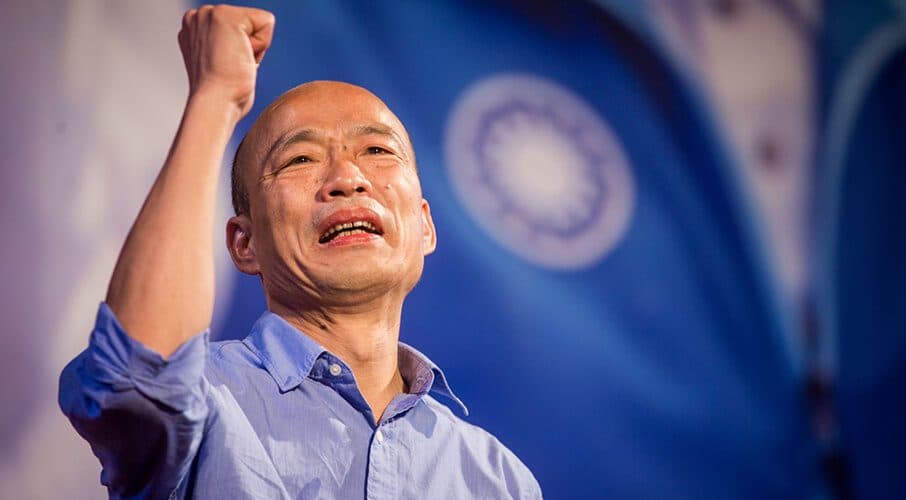
Taiwan's top legislator took his case to Washington this week, in a visit that put the island's politics on display at the heart of American power. Han Kuo-yu, speaker of Taiwan's Legislative Yuan, met US House Speaker Mike Johnson on Friday at the head of a bipartisan delegation of Taiwanese lawmakers.
The meeting was a study in symbolism as much as substance. For Taiwan, being received by the leader of the US House is a public signal of support from one of its most important partners, the kind of gesture that carries weight far beyond the room it happens in.
What was on the table
The conversation ranged across the issues that define the relationship. Security cooperation led the agenda, alongside Taiwan's push to build up its own defense capabilities and a notable focus on the drone industry, a sector that has become central to modern deterrence. The two sides also discussed Taiwan's long running effort to take part in international organizations, a goal complicated by Beijing's claims over the island.
Han used the visit to express gratitude, thanking Johnson for what he called steadfast and longstanding support for Taiwan and for advancing relations between the two governments. The language was warm and deliberate, the diplomatic register of a guest who wants the partnership underlined in public.
A delegation, not a solo act
This was not a single handshake but a broader charm offensive. Han met more than 30 lawmakers from both American parties, including former House Speaker Nancy Pelosi, whose own visit to Taiwan years ago became a flashpoint in relations with Beijing. The breadth of those meetings was the point, a demonstration that support for Taiwan crosses the usual party lines in Washington.
The trip also followed a recent visit to the US capital by the chairwoman of Han's party, signaling a coordinated effort to keep Taiwan's voice present in American politics during a sensitive period.
The politics behind the visit
What makes the trip especially striking is who made it. Han is a senior figure in the Kuomintang, the opposition party traditionally seen as favoring a more conciliatory posture toward mainland China. His warm reception in Washington complicates any simple reading of Taiwanese politics, showing that engagement with the United States is not the preserve of one camp alone.
For a politician from the KMT to lead a delegation seeking closer US security ties sends a message at home and abroad. It suggests a broad consensus in Taipei that the relationship with Washington is too important to be treated as a partisan issue, whatever the differences over how to handle Beijing.
Why it matters
Every high level contact between Taipei and Washington is watched closely, because each one tests the boundaries of a relationship that Beijing insists should not exist at all. A meeting between the two legislatures' top figures is the sort of event that can draw a sharp response from China, which views such exchanges as encouragement of an island it considers its own.
For Taiwan, that risk is part of the calculation. Visible support from Washington is one of the few tools it has to strengthen its position, and a public meeting at the top of the US House is about as visible as it gets. The handshake will fade from the headlines, but the signal it sends about where Taiwan stands with its most powerful friend is meant to last.