
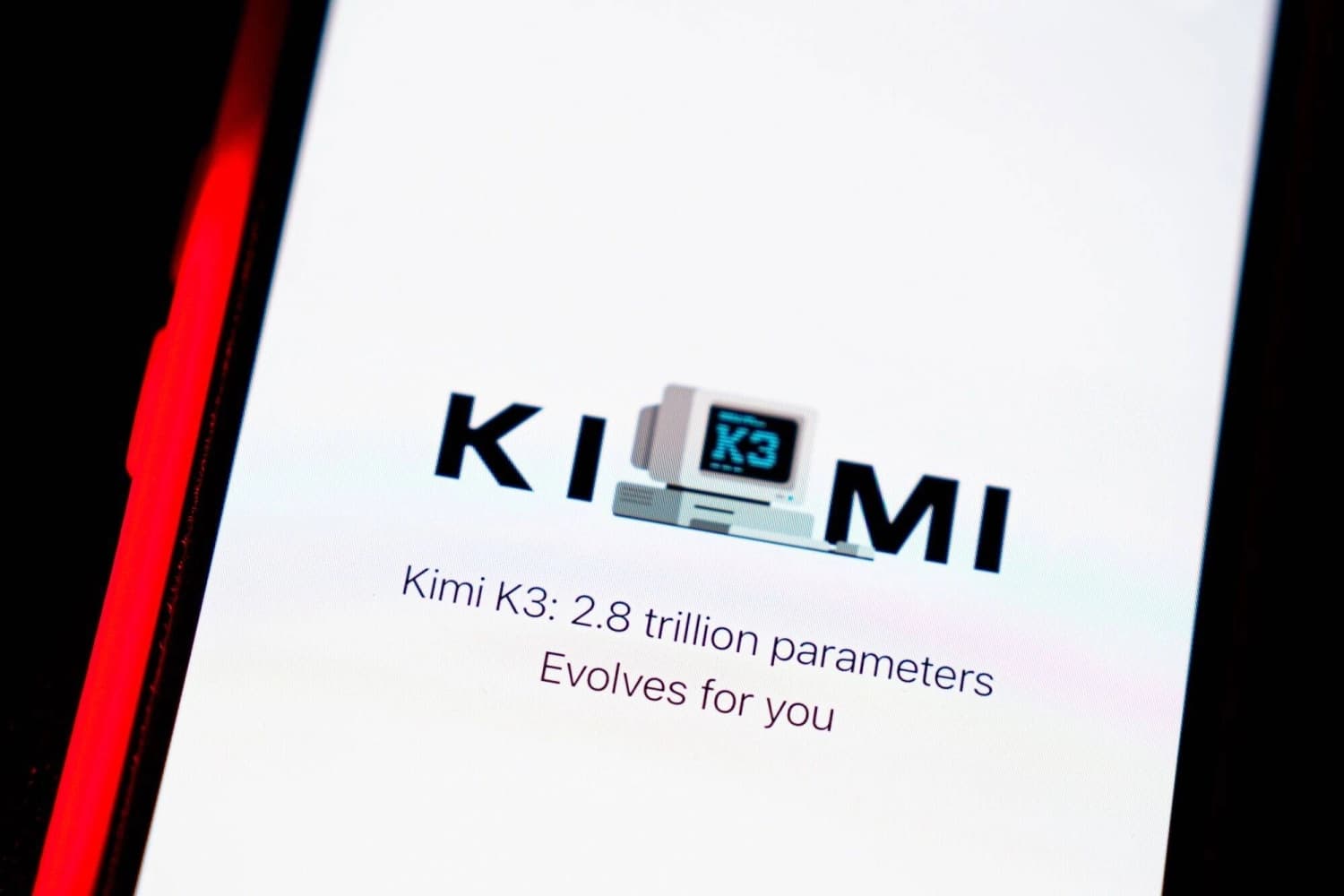
For three years the working assumption in Washington has been that starving China of the most advanced chips would keep its artificial intelligence labs a comfortable step behind. Moonshot AI has just complicated that assumption in the most public way possible. The Beijing company has released Kimi K3, a model of 2.8 trillion parameters that it is giving away as open weights, and in doing so it has produced the largest freely downloadable AI system anyone has built to date.
The number alone is designed to grab attention. At 2.8 trillion parameters, K3 is the first open model to reach into the territory that until now belonged only to the closed, tightly guarded systems of the biggest American labs. Moonshot is not merely matching the scale of its rivals, it is handing that scale to the world, letting developers everywhere download the model, run it on their own machines and adapt it to their own ends without asking anyone's permission.
What is actually under the hood
The headline size hides a more efficient design. K3 is built as a mixture of experts, which means that instead of firing every one of its parameters on each request, it calls on only a small subset at a time, activating 16 specialists out of a pool of 896 for any given task. That approach lets the model carry an enormous store of knowledge while keeping the cost of running each query far lower than the raw parameter count would suggest.
The capabilities stretch beyond text. K3 ships with a context window of a million tokens, enough to hold entire books or sprawling codebases in view at once, and it can natively make sense of images alongside words, with support for video reported as well. Moonshot has wrapped these features around its own attention framework, the kind of homegrown engineering that shows the company is not simply copying foreign blueprints but building its own.
Good, but not yet the best
It would be a mistake to oversell the achievement. On overall performance K3 still sits behind the frontier, trailing Anthropic's Claude Fable 5 and OpenAI's newest flagship in the broad measures that matter most. The very top of the field remains American, and Moonshot has not dethroned it. What the company has done is arrive within striking distance, close enough that the gap is now measured in increments rather than generations.
In narrower contests the picture flatters K3 more. Moonshot says the model outperformed every other system in its own evaluation suite outside the two leaders, including some of the most respected names from the United States, particularly on coding and on the agentic tasks where a model has to plan and act across many steps. In one blind test of front-end coding run by an independent arena, K3 came out on top, edging ahead of even the model that leads it overall.
The story is no longer whether China can build a frontier-class model. It is how quickly the distance to the front keeps shrinking.
The power of giving it away
The decision to release K3 as open weights is as strategic as the model itself. By putting a system of this size into the hands of any developer who wants it, Moonshot instantly plants itself at the center of a global community of builders, researchers and startups who will improve, extend and depend on its work. Openness buys influence, and it turns a single company's model into a shared foundation that others come to rely on.
That is a very different bet from the one the leading American labs have made, guarding their best systems behind paid interfaces and keeping the weights locked away. Each approach has its logic, but the open path has a particular appeal for a challenger trying to win mindshare quickly. If the world's developers grow used to building on Chinese open models, the balance of the industry shifts in ways no benchmark score fully captures.
A message about export controls
The deeper significance lies in what K3 says about the limits of restriction. The United States has spent three years tightening the flow of advanced semiconductors to China precisely to prevent moments like this one, and yet here is a Chinese lab shipping a model at the outer edge of what anyone has open-sourced. Constraints on hardware have clearly made the work harder and more expensive, but they have not made it impossible, and necessity has pushed Chinese engineers toward cleverer and leaner ways of squeezing performance from the chips they can get.
None of this means the race is run. The American leaders still hold the top, and holding it will keep them investing at a scale few can match. But Kimi K3 is a marker that the contest is genuinely competitive, that China's best labs are closing rather than stalling, and that the comfortable lead many assumed would last has grown thinner than expected. The next model, whoever ships it, will be watched with a new sense that the gap is there to be closed.