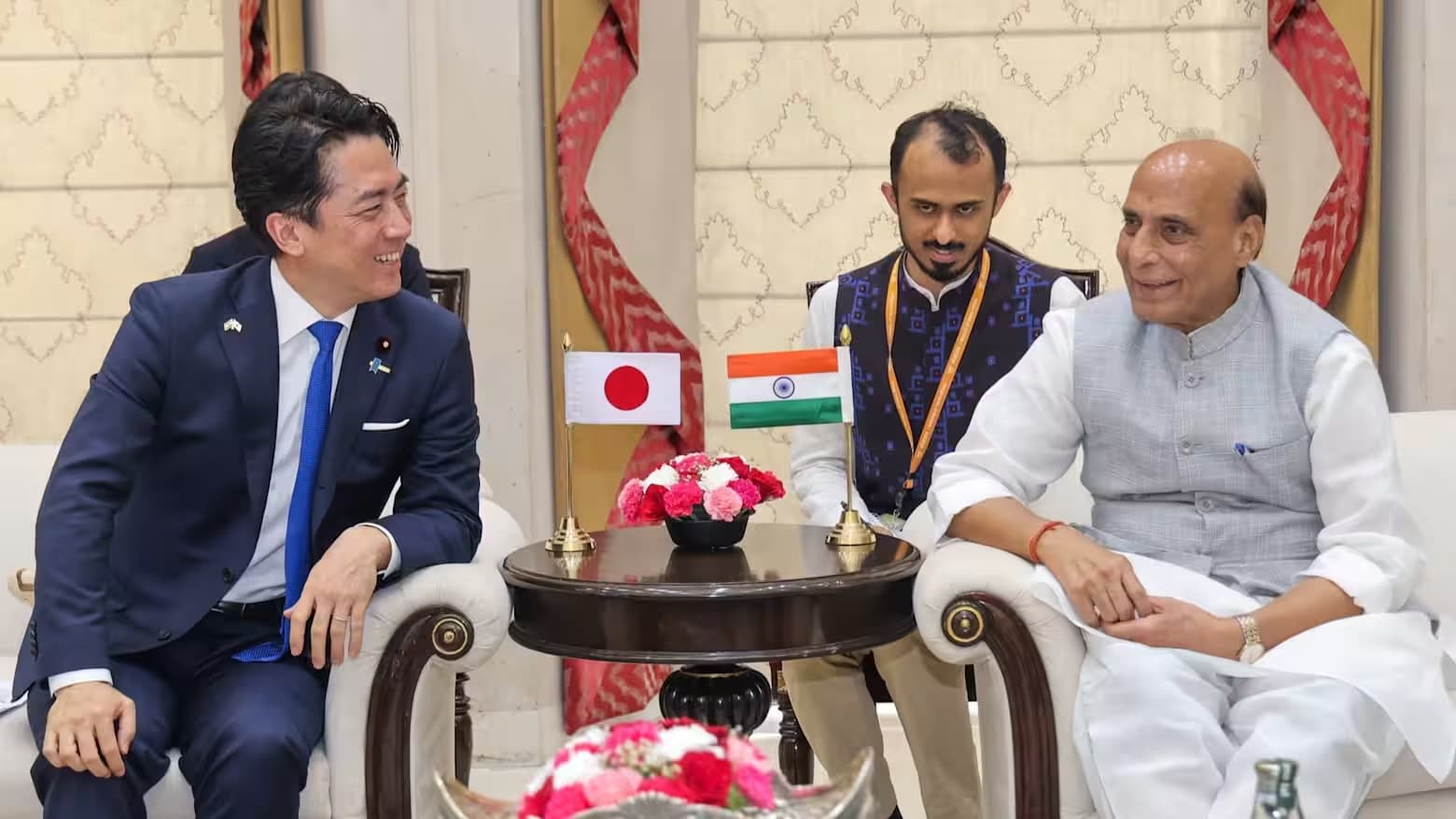
India and Japan put pen to paper on a new maritime security arrangement in New Delhi on Thursday, giving their navies a formal framework to work more closely together at a moment when both governments are increasingly focused on what lurks beneath the surface of Indo-Pacific waters. Indian Defence Minister Rajnath Singh and his Japanese counterpart Shinjiro Koizumi signed the Memorandum of Arrangement on Maritime Security Cooperation after a round of bilateral talks.
The headline commitment in the pact is a pledge to maximise synergies on mine countermeasures, the unglamorous but critical work of detecting and clearing sea mines that could otherwise choke off shipping lanes in a crisis. Both the Indian Navy and the Japan Maritime Self Defense Force have invested heavily in minesweeping fleets, and the new arrangement gives them a formal channel to pool expertise, train together and compare notes on undersea threats rather than developing that capability in isolation.
Shipbuilding on the table too
Mine warfare was far from the only item on the agenda. The two sides also agreed to assess opportunities for joint development in naval shipbuilding and design, an ambition that would pair Japan's advanced marine engineering with the scale of India's domestic shipyards under the government's Make in India push. Neither side detailed a timeline for what that cooperation might produce, but the language signals an appetite to move beyond joint exercises and into the more binding territory of co designed hardware.
Singh also welcomed Tokyo's recent review of its own rules governing the transfer of defence equipment and technology, a shift that has made it easier for Japanese firms to export military hardware to partner nations. One flagship item already flagged for transfer is a shipborne integrated communications antenna system known as UNICORN, which the two governments have pointed to as an early, concrete example of what the broadened framework can deliver.
Deepening operational cooperation in the field of maritime security in a practical and effective manner.
That phrase, drawn from the two ministries' joint statement, sums up the intent behind the pact. Rather than another broad statement of shared values, the arrangement is built to translate into information sharing, ship repair and logistics support, search and rescue cooperation, humanitarian assistance planning, and exchanges between the two countries' special operations forces.
A message about open sea lanes
Singh and Koizumi used their joint appearance to voice opposition to unilateral attempts to alter the status quo at sea and to any moves that impede freedom of navigation and overflight, language that both capitals have used before when addressing tension in contested Indo-Pacific waters. Neither minister needed to name a specific country for the target audience to be obvious, given how often similar language has surfaced in statements about maritime friction in the region.
The agreement also sets a framework for expanding the exercise calendar the two militaries already share. India and Japan already run the army focused Dharma Guardian, the naval JAIMEX drills and the air exercise Veer Guardian, and officials from both sides indicated the new pact should make it easier to add mine countermeasures drills and undersea security scenarios to that rotation going forward.
Part of a broader Indo-Pacific push
The pact lands as both New Delhi and Tokyo continue to widen their defence ties with a network of like minded partners across the region, from expanded logistics agreements to more frequent joint patrols. For India in particular, deeper mine countermeasures cooperation addresses a gap that officials have flagged for years, since sea mines remain one of the cheapest and most disruptive tools available to any actor looking to threaten commercial shipping without engaging in open conflict.
Whether the arrangement quickly produces new joint capability or takes years to mature into something concrete, the signing itself marks a shift in tone. Two of Asia's most capable navies have now put mine hunting and warship design on the same page as a formal bilateral document, rather than leaving that cooperation to informal coordination between port calls.