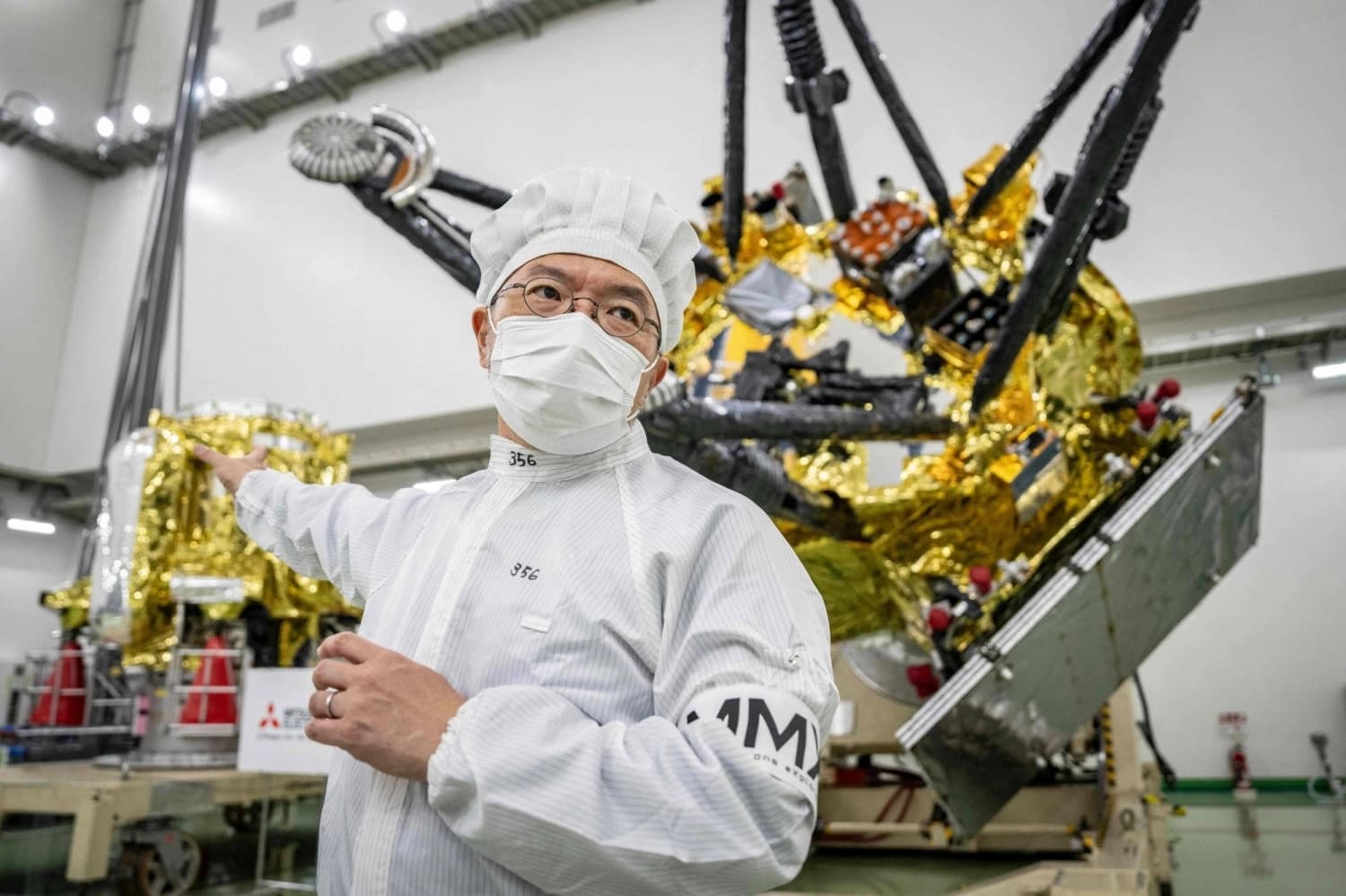

Japan's Defense Ministry has unveiled plans to build satellites equipped with artificial intelligence capable of analyzing surveillance data while still in orbit, a shift meant to compress the time between detecting a target and authorizing a long range missile response. Rather than beaming raw surveillance data down to ground stations for human analysts to sort through, the new satellites would process that information in space and pass along a refined picture, cutting out a step that currently adds precious minutes to a decision chain the military wants measured in seconds.
The goal is to feed better, faster information into Japan's counterstrike capability, the ability to hit back at long range that Tokyo has been building out since its 2022 defense strategy shift. Predicting how a target is likely to move before a missile is even launched, rather than reacting to stale data, is central to the pitch, since even small improvements in accuracy and timing can matter enormously when the response window is short.
Built at home, on purpose
Every layer of the artificial intelligence software running on the satellites is being developed domestically, a deliberate choice by the ministry rather than a matter of convenience. Relying on foreign built AI systems for something as sensitive as strike decision support would leave Japan exposed to supply disruptions or software dependencies it cannot fully control, a risk officials have decided is not worth taking even if it means a slower, more expensive development path in the near term.
A prototype development contract tied to the effort was awarded to NTT Data at the start of the year, kicking off work that is expected to run for several years before any satellite reaches orbit. Demonstrator satellites are slated for construction across fiscal years 2027 through 2029, with ground testing and the program's first orbital validation runs targeted for fiscal year 2030, a timeline that reflects how much engineering has to be proven out before the system can be trusted with anything resembling a live decision.
Part of a much bigger space budget
The satellite program sits inside a defense space budget that has grown dramatically in just a few years, climbing from seventy nine billion yen in fiscal year 2022 to five hundred forty billion yen in fiscal year 2025, a roughly seven fold increase that signals how central space based capability has become to Japan's broader military planning. That growth mirrors the emphasis the ministry has placed on artificial intelligence and unmanned systems elsewhere in its budget requests, treating orbital sensing and analysis as another front in the same modernization push rather than a niche side project.
Speed as its own form of deterrence
Military planners have long argued that the credibility of a counterstrike capability depends as much on how fast a country can act as on the weapons themselves, since a slow decision chain gives an adversary confidence that a strike can be absorbed and outrun. By pushing analysis into orbit and letting AI narrow down what a human commander actually needs to see, Japan is betting that shaving time off that chain does more for deterrence than simply adding more missiles to the inventory.
Whether the approach performs as intended will not be clear for years, given the program's fiscal 2030 target for first orbital tests. But the decision to build the entire AI stack domestically, even at the cost of a longer runway to deployment, signals how seriously Tokyo is treating the question of who controls the software making decisions in the moments before a missile leaves the launcher.