
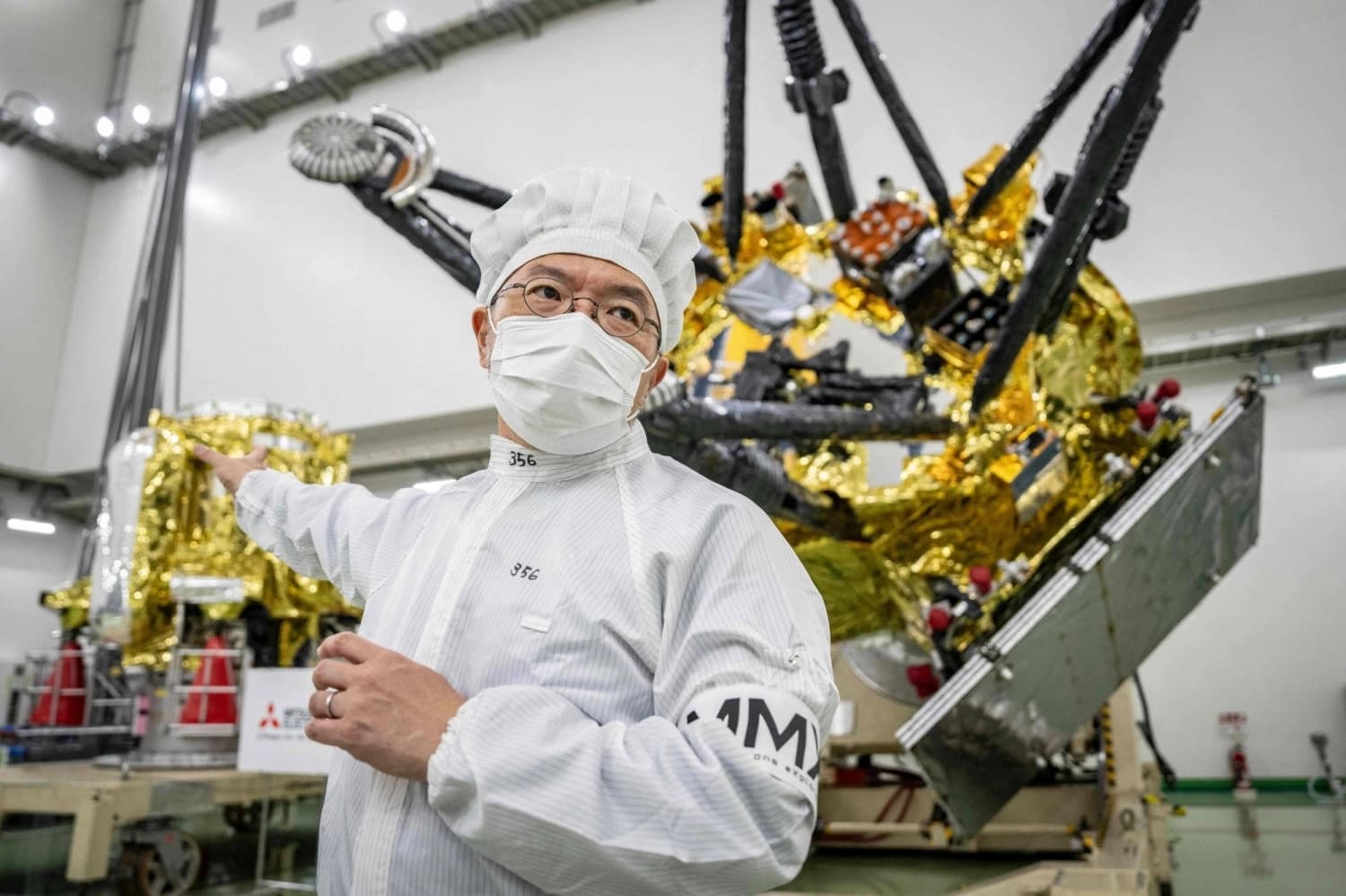
In a spotless clean room in Japan, engineers are putting the finishing touches on a spacecraft designed to do something no mission has ever managed. The probe, known as MMX, is built to travel to Mars, land on its larger moon Phobos, gather a sample of its surface and bring that material back to Earth. If the mission unfolds as planned, Japan will become the first nation to return a physical piece of the Martian system, a feat that would place it at the front of a quietly intense global race.
The timeline is now coming into focus. The spacecraft was delivered earlier this year to the launch site at Tanegashima, and liftoff is scheduled for the closing months of the year. From there the probe faces a long cruise to Mars, a delicate operation around Phobos, and a return journey that would deliver its precious cargo to Earth in 2031. It is a mission measured in years and in nerve, with a single small container of dust as the prize at the end of it.
A tiny moon with a big mystery
Phobos may be modest in size, but the questions it holds are anything but. Scientists have long argued over where the two Martian moons, Phobos and its smaller companion Deimos, actually came from. One camp believes they are asteroids that strayed too close and were captured by Mars and its gravity. Another holds that they formed from the debris thrown up when a large body slammed into the planet long ago. The two explanations imply very different histories, and settling the argument requires the one thing no one has ever had, which is a sample to study.
MMX is designed to end that debate. By collecting more than ten grams of material from the surface of Phobos and returning it to laboratories on Earth, the mission would let scientists read the moon's chemistry and mineralogy directly rather than inferring it from a distance. Whichever origin the evidence supports, the answer would reshape how researchers understand not just these two moons but the violent early history of Mars itself.
Why the moon may hold pieces of Mars
There is an added prize that makes Phobos even more tempting. The moon orbits so close to Mars that over eons it has almost certainly been dusted with debris blasted off the planet's surface by asteroid strikes. That means the soil MMX gathers may contain tiny fragments of Mars itself, delivered to Phobos across space and preserved there. Studying that material could offer clues about the red planet, including hints relevant to the long-running question of whether Mars ever harbored the conditions for life.
In that sense a mission to a Martian moon doubles as a mission to Mars by proxy. Reaching the planet's surface, sampling it and flying home remains an enormously difficult and expensive undertaking, and no one has done it yet. Phobos offers a cheaper and more accessible way to get at least some Martian material into the hands of scientists years before a full surface sample return is likely to succeed.
A handful of dust from a moon most people have never heard of could carry the first pieces of Mars ever brought to Earth.
Built on a proven Japanese specialty
Japan comes to this challenge with a rare pedigree. Its space agency has already pulled off two celebrated sample return missions, sending the Hayabusa probes to distant asteroids and bringing fragments of them back to Earth. Those journeys made Japan the world leader in the demanding art of touching a far-off body, collecting a piece of it and returning it intact. MMX is the bold next step, applying that hard-won expertise at a far greater distance and to a target circling another planet.
The mission is also a genuinely international effort, drawing contributions from partners in the United States and Europe, including a small rover developed by French and German engineers to explore the surface ahead of the sampling. That collaboration spreads both the cost and the scientific reward, and it ties Japan's ambitions into a wider global push to understand Mars and its surroundings. Success would be celebrated well beyond Tokyo, even as the achievement itself would belong first to Japan.
A high-stakes gamble
None of this is guaranteed. Operating around Phobos is fiendishly hard, because the moon is small and its gravity is so weak that a spacecraft cannot simply land in the ordinary sense but must instead settle onto the surface with extreme care. A single misjudgment across a mission spanning years and hundreds of millions of kilometers could undo the entire effort. Space is unforgiving, and the history of exploration is littered with bold attempts that fell short at the final step.
Yet the potential reward justifies the risk. A successful MMX would hand Japan a landmark achievement, deliver scientists their first laboratory access to the Martian system, and possibly place actual pieces of Mars under the microscope for the very first time. As the probe waits in its clean room for the journey ahead, it carries not just instruments and fuel but a chance for Japan to write its name into the history of planetary exploration. The countdown to that attempt has begun.